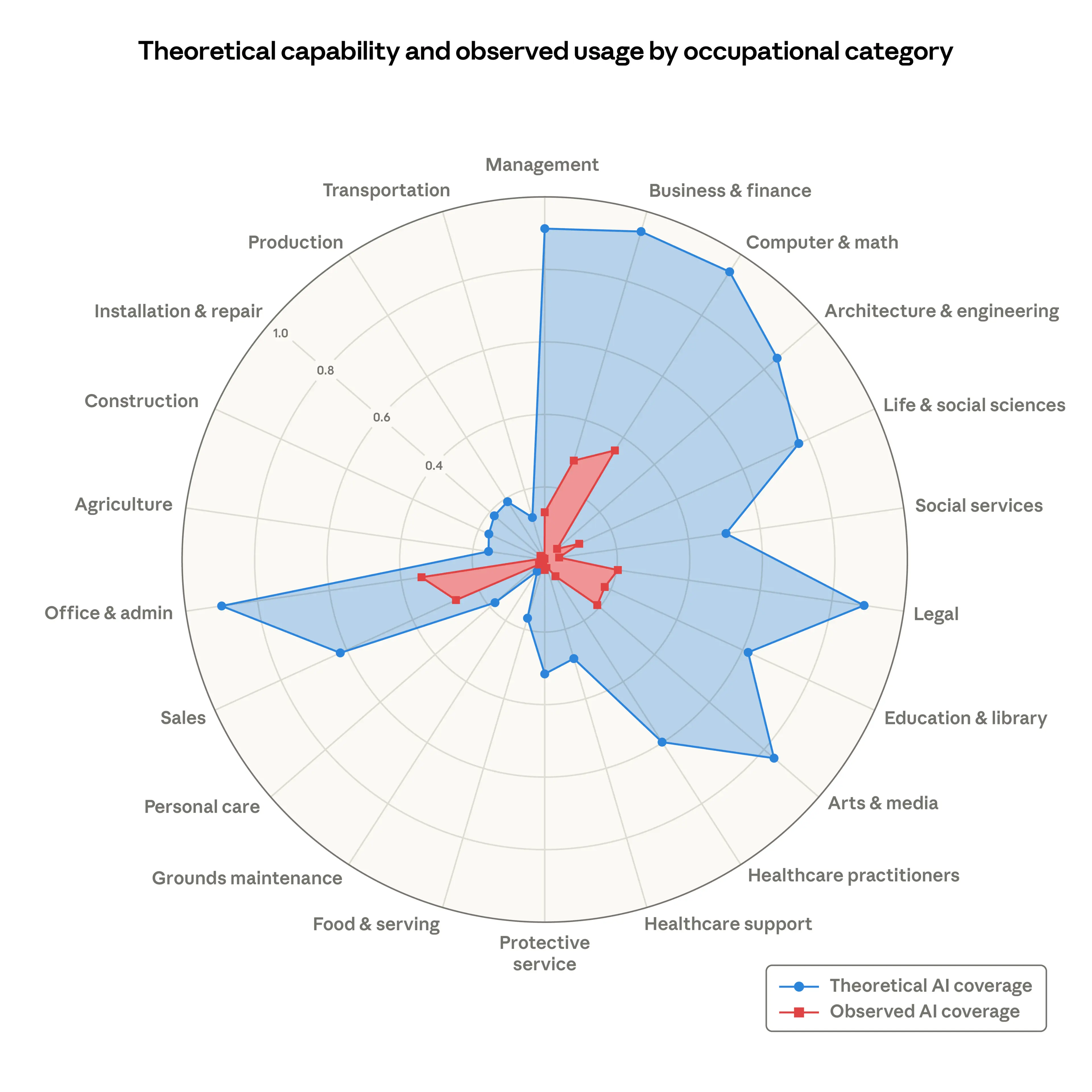
The research analyzes millions of real-world interactions with Anthropic’s AI assistant Claude to understand how AI is being used across different types of work. Instead of estimating what AI might theoretically be capable of doing, the study measures “observed exposure,” which examines how frequently AI is actually used to perform tasks associated with particular jobs.
To map these interactions to occupations, the researchers used task classifications from the U.S. Bureau of Labor Statistics and the O*NET Program, which categorize the types of activities involved in hundreds of professions.
The report finds that only about four percent of occupations have at least seventy-five percent of their tasks exposed to AI capabilities. However, approximately thirty-six percent of occupations have at least a quarter of their tasks exposed to AI systems, indicating that many jobs may experience partial task changes rather than full automation.
Researchers also distinguished between two ways AI is used at work: augmentation and automation. Augmentation refers to situations in which AI assists humans in completing tasks, while automation refers to AI performing tasks independently. The study found that fifty-seven percent of AI use cases involved augmentation, compared with forty-three percent involving automation.
The occupations most affected by AI exposure tend to involve text-based or analytical work, including roles such as computer programmers, financial analysts, and customer service representatives. Jobs that rely more heavily on physical activity or in-person services showed significantly lower levels of exposure.
The study also examined employment data to identify whether workers in highly exposed occupations have experienced increased unemployment since the widespread release of generative AI systems in late 2022. According to the report, there has been no clear evidence of a systematic rise in unemployment among these occupations during that period.
However, the researchers noted changes in hiring patterns for younger workers entering the labor market. Job-finding rates for workers aged 22 to 25 in occupations with higher AI exposure have declined compared with levels recorded in 2022.
Anthropic stated that the findings represent early evidence of AI’s effects on employment and that continued monitoring will be necessary as AI systems evolve and their adoption increases across industries. The report concludes that current data suggests artificial intelligence is primarily altering how tasks are performed within jobs rather than eliminating large numbers of roles altogether.