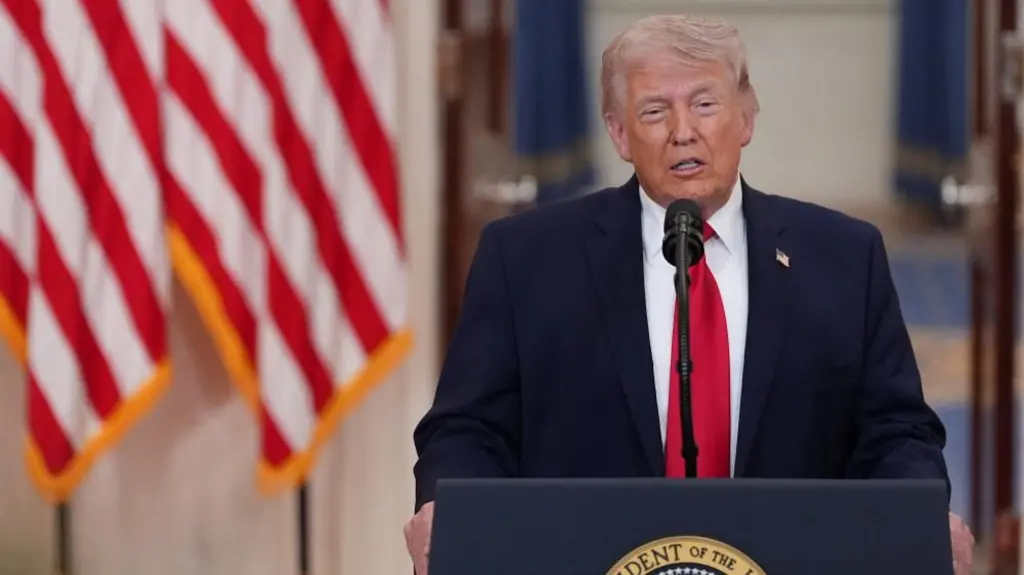
Alliance Faces Existential Crisis Over Middle East Conflict
The NATO alliance is confronting what analysts describe as its gravest crisis since its founding in 1949, as President Donald Trump threatens to withdraw the United States from the 76-year-old security pact over European allies' refusal to support military operations in Iran. The escalating tensions have exposed deep fractures in transatlantic relations and raised fundamental questions about the future of Western collective defense.
Trump's frustration centers on European nations' unwillingness to deploy naval forces to reopen the Strait of Hormuz, a critical shipping lane that Iran has effectively closed since the US-Israeli air war began on February 28. "Wouldn't you if you were me?" Trump asked Reuters when questioned about potentially leaving NATO, signaling his exasperation with allies he views as failing to support America in a time of need.
European Leaders Hold Firm Against Military Involvement
Despite Trump's increasingly aggressive rhetoric, European leaders have maintained their position against direct military engagement in the Iran conflict. French President Emmanuel Macron declared that opening the Strait of Hormuz by force is "unrealistic," while Spanish Prime Minister Pedro Sánchez went further by banning US forces from using Spanish military bases and closing Spanish airspace to American bombers conducting Iran operations.
"There is too much talk… We all need stability, calm and a return to peace. This is not a show! You have to be serious," Macron stated during a visit to South Korea, directly criticizing Trump's volatile statements.
An online forum organized by British Foreign Secretary Yvette Cooper, attended by representatives from 41 countries including France, Germany, and Gulf states, produced strong criticism of Iran but stopped short of promising military support. Participants agreed only to increase diplomatic pressure and pursue sanctions - a response that falls far short of Trump's demands for naval deployments.
NATO's Core Principle Under Question
The crisis has fundamentally undermined confidence in NATO's Article 5 mutual defense commitment, which has served as the cornerstone of European security for decades. Max Bergmann, former State Department official and director of the Europe, Russia, and Eurasia Program at the Center for Strategic and International Studies, told Reuters: "This is the worst place NATO has been since it was founded. It's really hard to think of anything that even comes close."
Even NATO Secretary-General Mark Rutte, who as recently as February dismissed the idea of Europe defending itself without America as a "silly thought," now faces a reality where many officials consider US disengagement the default expectation. General François Lecointre, France's former armed forces chief, questioned whether the alliance should even retain its name: "NATO remains necessary, but we must be capable of thinking of NATO without the Americans."
Lebanon Becomes New Flashpoint
The crisis has been compounded by Israel's expanding military operations in Lebanon, where more than a million people—nearly 20% of the population—have been displaced by Israeli strikes targeting Hezbollah. The Lebanese government, led by President Joseph Aoun and Prime Minister Nawaf Salam, has taken unprecedented steps to distance itself from Iran, including banning Hezbollah's military activities and expelling Iranian Revolutionary Guard Corps members.
However, Israel's apparent plans for a prolonged occupation of southern Lebanon—with some Israeli officials calling for annexation of territory up to the Litani River—threaten to destabilize the fragile Lebanese state. Maha Yahya, director of the Malcolm H. Kerr Carnegie Middle East Center, warned in Foreign Affairs that "a Lebanon plunged into abject chaos benefits nobody" and could trigger renewed civil conflict.
Economic and Strategic Consequences Mount
The war's economic impact extends far beyond the Middle East. Global oil prices have surged, airline executives warn of jet fuel shortages that could ground flights across Europe, and financial markets have reacted negatively to Trump's unpredictable statements. The closure of the Strait of Hormuz—through which roughly 20% of global oil supplies normally pass—has created supply chain disruptions affecting industries worldwide.
Trump administration officials have expressed particular frustration over what they view as European restrictions on US military operations, including limitations on airfield and airspace use. Secretary of State Marco Rubio had a tense exchange with EU foreign policy chief Kaja Kallas at a G7 meeting, with Rubio irritably noting that while the US tries to end conflicts, Europe is "welcome to mediate if it wanted to."
Legal and Political Obstacles to US Withdrawal
Despite Trump's threats, actually withdrawing from NATO faces significant legal hurdles. A 2023 law championed by then-Senator Marco Rubio requires two-thirds Senate approval for any NATO withdrawal—a threshold currently considered impossible to reach. However, analysts note that as commander-in-chief, Trump could effectively undermine the alliance by simply refusing to defend NATO members under attack, rendering Article 5 meaningless without formal withdrawal.
The broader geopolitical reality also complicates disengagement. Europe remains America's largest export market, with 48 of 50 US states exporting more to Europe than to China. Nearly 60% of foreign investment into the United States comes from Europe, supporting millions of American jobs. A US Chamber of Commerce report emphasized that NATO serves as the primary security guarantor of this crucial economic relationship.
Proposals for Alliance Restructuring
Some Trump administration officials have floated alternative security arrangements. Lieutenant General Keith Kellogg suggested NATO needs to be "redrawn," potentially creating a new alliance with Japan, Australia, and willing European nations like Germany, Poland, and even Ukraine. Such proposals reflect growing frustration with traditional NATO structures but have received little support from European capitals wary of fragmenting existing security frameworks.
British Prime Minister Keir Starmer has indicated the UK would pivot more closely to the European Union, building stronger defense and economic ties independent of US leadership. This shift represents a significant departure from Britain's traditional role as a bridge between America and Europe.
Historical Parallels and Future Uncertainty
NATO has weathered serious crises before—from the Suez Crisis in 1956 to France's withdrawal from integrated military command in 1966 to disagreements over the Iraq War in 2003. Each time, the alliance ultimately emerged stronger. However, current tensions feel qualitatively different to many observers, with Trump's unpredictability and the fundamental disagreement over Iran creating unprecedented strain.
The upcoming NATO summit in Ankara in July—now just 100 days away—will be crucial. Originally planned as an ambitious agenda-setting meeting, it must now focus on damage control and relationship repair. Turkish President Recep Tayyip Erdoğan's ability to bridge different alliance factions and his relationship with Trump may prove decisive.
"I do think we're turning the page of 80 years of working together," said Julianne Smith, former US ambassador to NATO under President Biden. "I don't think it means the end of the transatlantic relationship, but we're on the cusp of something that's going to have a different look and feel to it."
The Path Forward
As the Iran war continues with no clear end in sight, the fundamental question facing NATO is whether the alliance can survive such profound disagreement over a major conflict. European officials argue they cannot support what they view as an unnecessary and potentially catastrophic war, while Trump administration officials insist that allies who won't support America in crisis have no claim to American protection.
Military expert Carlo Massala told Der Spiegel that if the Iraq War was NATO's "near-death experience," the Iran war could be "a heart attack without the possibility of resuscitation." Whether diplomatic efforts can bridge this divide before the Ankara summit—or whether the alliance will fundamentally transform or even fracture—remains one of the most consequential questions facing the international order in 2026.